Showing posts with label ETrends. Show all posts

Friday, December 16, 2011

The 5 Most Innovative USB's You Will like to Own.


Right from its inception in the mid 1990s, the 3 inch long device popularly known as USB or Universal Serial Bus has gain wide acceptance, on the context of its usability, data reliability and most importantly portability. Seven giants IBM, Intel,Compaq, NEC, DEC, Nortel and Microsoft came together in 1994 for the development of its first USB 0.7. Since then the device has gone a huge upgradation from USB 1.0 supporting 1.5Mbit/s to the most  recent USB 3.0 which gives a maximum data transmission rate of 5Gbit/s.

An estimate says that till 2008 6 billion USB devices have been sold and about 2 billion USBs are being sold each year. With this increasing demand, definitely more addons are expected in the drive. Here is our attempt to list the top 5 most innovative concepts which will change the way you look at an USB. 

5)  USB/Battery duo Avatar

A rechargable AA battery which pop out as an USB connector and can also be used as a battery. Though the concept proposed by Wonchul Hwang is one of its kind but it raise a very basic question as; what will happen to the data if the battery gets overheated while charging.... 


The product is in concept development stage, and we can expect that many such issues will be addressed. Till that time lets move on...

4) Mnemosyne a $10,000 USB drive

Memnosyne is a cube measuring 72mm on each side; having 5 polished silver pieces housing a black piece, which is the real USB. The manufacturer claims that their USB is more of a puzzle which needs to be solved to reach the storage device inside it. So, even if your cube gets stealed, the thief has to be smart enough to solve the puzzle and get your data.


OK for the people who like solving Rubik's cube may find it interesting to solve and build the cube each time they transfer the data. But with the price tag that it has... it is definitely gonna be a status symbol than a peripheral.
If you feel like buying check more at Mnemosyne.


3) Clap the USB Camera Device

We are all snap happy people. Clicking photos, sharing it on social network has became our hobby. Though we can use our mobiles to click random photos and directly upload it on internet, but still I feel it is in no substitute to a camera, when we want to click some good quality images.
But transferring images from camera to our computer is a tedious job. Remove memory card, find a card reader,or sometimes find the data cable to directly connect the camera. Uuff... a lengthy process. And it becomes more annoying when we cannot find the data cable when we are desperately searching for it. 


Thank God, somebody has paid heed to this problem and we have now a solution in the form of a built in USB inside a camera. The CLAP camera, as it is said is a tiny 2 megapixel camera with image resolution of 1280 x 1024 and an ISO of 100.


It is capable 
of supporting
16 GB memory card, and the pictures can be directly uploaded via the USB 2.0.

Yes I can understand that it is of merely 2 megapixel, and the mobiles available now a days provide us with a better resolution, but lets not forget that it is a very new concept and with this size a new generation of camera or you can say USB technology is getting evolved.
Check out this video for a better overview.


2) Worlds most secure Flash Drive

The military grade AES-256 encryption, only FIPS 140-2 Level 3 flash drive (validation required to be used in government agencies), waterproof, tamper-resistent, built in malware protection, secure browser are some of the unique selling point of Ironkey USB flash drives.


IronKey validation covers not only the cryptographic module but also the circuit board, memory, and authentication system. It also provide you with the option of  remote disable or deny features. If this is not enough it can also self destroy itself giving an extra security assurance. So if you are feeling to buy one, your options will be 1, 2, 4, 8 or 16Gb. Get the full specification from the PDF.

1) iTwin

The first thing which comes to our mind is Oh!! another Apple product in the market...  :) No, it is not an Apple product. Don't get confused with that small "i". 
 iTwin is a USB dongle which is a blend of innovative idea and futuristic design.


We all have realized the problem of large file transfer especially media files. Suppose we want to share a media file with our friend who lives in some different state. Then the usual way is to upload the file to some free uploading site and then we can share the URL, from where he can download. A very time consuming process.

It is this issue which iTwin addresses. The manufacturers of iTwin promises that there device is capable of transferring any data to a person any where in this world.

All you need to need to do is you will have to connect the double ended USB dongle to your PC. The device will autorun its software and will share an encrypted key. Now you detach the USB into two parts and take any half to any where in this world. The only thing you would require is an Internet connected in both the PC to make the transfer possible.

But what will happen if you lost one part! Will any one have the access to use your data. Don't worry,  your data will be secure. The reason is when a connection is established the owner will be sent a remote disable code by email. This code can also be used to break the connection between the two iTwins. 
This device has won many awards in the innovation and design category. Click here for the Official website of iTwin.

 
Would you like to see how an USB is manufactured. Then check out this video. Taken in the factory of Kingston.


Liked this article!!! Leave your footprints behind with a comment.  It will make me feel happy.


read more...

Sunday, December 19, 2010

Understanding The Mysterious World Of Memristor


<< Fig shows the concept of HP's memristor circuit a mesh of perpendicular wires known as crossbar arrays; in which memristors are sandwiched between the crossing points. 

You may think what is so special about Memristor?
Hmm... I can give you a reason that it can lead to analog circuits that can think like human brain... :)


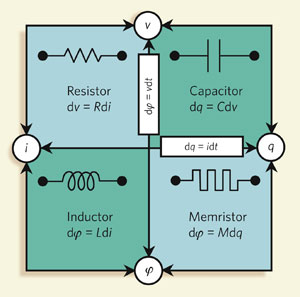
The concept of Memristor starts nearly 4 decades ago when in the year 1971 Leon Chua (a professor of electrical engineering at the university of California ) postulated the existence of a fourth fundamental element after examining the relationships between charge and flux in capacitor, inductor and resistor. Till that time for nearly 150 years capacitor, inductor and resistors were considered as the three fundamental passive circuit elements.


The 4 element would give the same relationship between charge and flux that is given by a resistor for voltage and current. Such a fundamental element would behave like a resistor whose value would vary according to the current passing through it; but it would be able to remember that value even after the current disappears.

Long since it was theorized no one was able to built it. It became a concept of profound curiosity. But in the year 2008 the researchers of  Hewlett-Packard Stanley Williams and his group revealed that they have discovered the 4th element. "The Memristor". 


         Memresistor crossbar architecture
 
The architecture of Memresistor is a mesh of perpendicular wires known as crossbar arrays; in which memristors are sandwiched between the crossing points.  

Memristor is a two terminal device whose resistance depends upon the magnitude and polarity of the voltage applied to it and the length of the time for which the voltage has been applied. If you  turn off the voltage the memristor is able to remember the recent resistance until the next time you turn it on whether it is the next day or a year later.. That means if you are working on a spreadsheet on your computer, and you turn it off  without closing the documents you will get it as it is the next time you turn on your computer.

This effect can be duplicated by any circuit combination of  resistor, capacitor and inductor that is why the Memristor is termed as the 4th fundamental element.


                     Stanley Williams (left)

You need to boot your computer as the logic circuits do not hold their bits after the power is turned off. But as Memristor is able to remember its history, the wide application of it would be in non-volatile memories. So a computer driven by memristor won't need a reboot. Hence processing time would reduce with much flexibility in computation.

Overall Memristors can be made extremely small and they can be used to make analog circuits working on the same physical principles as a brain. Such a circuit would even lead to machines that can recognize patterns as humans do, real time data analysis for multiple sensors, intelligent physical infrastructure that can provide structural assessment and so on.


read more...

Thursday, December 16, 2010

Autonomous Power Efficient Microchips Generating Its Own Power.


          Solar cell generated within the layers of microchip

Power management and reduction of area required in a microchip are the two most important fields researchers are working upon.
Autonomous chips are created by harvesting solar energy to meet the power supply requirement of the chip by embedding a solar cell separately at its top. 


This type of chips won't require any battery or any other external energy sources. Hence they are very useful in wireless communication and space technology for their power efficiency.
But researchers have now succeeded in finding out a more efficient production process.They used a chip as a base and applied the solar cell to it layer by layer. 


One major advantage of this is that the chip would require fewer materials and hence performance would increase. Also it is highly suitable for industrial serial production.
The prototypes so far constructed showed that the electronics and the solar cell worked perfectly.
read more...

Wednesday, June 16, 2010

Changing Trends In Nanocircuits


Nanocircuits can be explained as a simple electrical circuit, at a dimension such that the quantum mechanical effects become important to be considered.  It's size ranges within 10-9 meters. The concept of nanocircuits arose when Intel's co-founder Gordon Moore suggested that the number of transistor that can be fabricated on a silicon integrated circuit will double every 18 to 24 months. More the number of transistors, more will be the speed of the computer.

But why should we worry about fabricating a transistor, can't we obtain a similar performance using resistors, capacitors or diodes?

The reason behind this is, transistors can act as a switch and can quickly turn on and turn off, regulating the flow of electricity. They can even amplify a signal ie; transforming a weak signal into strong signal. Most of the transistors we use in a circuit are silicon transistors. But opposite to this, when we are dealing with a nanocircuit silicon transistors cannot be used. It's because the silicon transistor of today are as small as allowed by the laws of physics and the resistivity of the circuit increases when the size shrinks to 30 nanometers.

So, it became a necessity for the Scientist and Engineers to device an alternate way if they wanted to add more functionality and reduce the size at nanoscale. So what they came up with, was a atomic scale wire made of carbon atoms and bonds. They named it Graphene (graphite+ene). Graphene is one atom thick  densely packed carbon atom bonds structured as a honeycomb crystal lattice. (See the above image) They are actually insulating materials but when the temperature is increased they act as conducting material.

Scientist are enthusiastic about graphene as the electrons meet with less resistance when they travel along graphene and also because they are faster and consume less power. Till now nobody knew how to produce graphene nanostructures on such a reproducible method. 


But recently some scientist claim that they have devised a simple one step process based on thermochemical nanolithography (TCNL) for creating nanowires from reduced graphene oxide.

Use of graphene interconnect could facilitate in integrated circuit performance once sizes drops to approximately 20nm. Also the high mobility of carriers in graphene could allow the fabrication of FETs with low channel resistance resulting in a high operational speed. The figure below shows a first ever logic gate and complementary inverter developed on graphene.

read more...

Tuesday, June 8, 2010

Apple's Solar Powered Touch Screen


To survive in this competitive world you need to explore new realms of technology, and "Apple" knows it very well. Today one of the major requirement is to cut down power required by a device or to use renewable energy sources.

Engineers from Apple have come up with a concept of Solar powered touch screen and they have filled a patent for the same. Though they have not released a solar powered gadget but their engineers see a wide potential in multitouch devices and believe to embed it in iPhone and iPad. Above is a diagrammatic representation of this concept where a solar cell is placed under a touch screen of hand held devices. 

The patent describes to use the parabolic reflectors as light channels to direct light to the solar cells underneath the touch screen. The solar panel will be designed such that it will absorb light from the top and also from the glass covering the back. But embedding a solar cell into a device and keeping it significant to gadget's cost is more challenging than stating a theory. In theory the solar cell will be able to use indoor lights rather than only direct sunlight. 

read more...

Friday, June 4, 2010

Smart Cars Communicating With Traffic Signal.


With the growing numbers of cars on the road, traffic is increasing at an enormous rate. Thus longer will be the time you will have to wait in the traffic signal. But consider a situation where your car need not have to wait, as every time you approach a signal it appears green. WOW! (that's what you will feel)

It's not a hypothetical thought, but with the blending between automotive and electronics industry many such smart cars are being produced. German car company AUDI has made a prototype named Travolution which can talk to traffic signals using LAN and UMTS links interrogating them about the color changing time.

The data sent by the signal is converted into graphics by the system. This then tells the driver what speed to adopt so that the next traffic changes to green before the car reaches it. In the same way if the car is waiting in the red signal the system will tell the driver how much time is left for light to turn green.

These Smart Cars Communicating With Traffic Signals will definitely help to save our time and most important, fuel consumption by 0.02 liter for every traffic signal stop. Though 0.02 may not look bigger but this small figure will help to reduce two million tons of CO2. A great life savior technology for our endangered Earth. What do you think about this technology? Do write to us.
read more...

Saturday, May 1, 2010

Generate Electricity With Every Move You Make Every Step You Take.


Have you ever wondered generating electricity merely by walking over a distance. If not then you will be amazed to know that scientist from Georgia tech University has developed a device which can generate power from body movement.

They have used Piezoelectric materials and drawn them into nanowires that can be woven into cotton shirt or housed into shoe hill. Piezoelectric crystals have a special characteristic that when they are subjected to force or pressure they produce electric signals. Though this electric signals are very weak but by cramming 20,000 nanowires into three square cm area can produce power in millivolt range.

With every move and every step you take pressure is applied on the piezoelectric crystal and electric signal starts flowing through the electrodes. It may not be possible to turn on an electrical appliance but at least atleast cellphones and ipods can be easily charged.


Single nanowires are invisible to naked eyes. Prof Z.L.Wang and his team at Georgia tech are using Zinc Oxide nanowires to built this nano generators. This nanowires are 50 to 200 nanometers in diameter and 5 micron in length. 2 thin electrodes are used and place between this 20,000 nanowires to drive current from it.

This arrangement helps to maximize the electricity produced by piezoelectric crystals. But if the zinc oxide is replaced by Gallium Nitride the power output could increase by 10 times.

If the device is not in constant motion then the nanowires will shut off and no electricity will flow. To rectify this Prof. Wang will develop supercapacitors to store the charge generated by the nanowires. 

Till now only a prototype is made and lots of work is needed to be done. It is likely to take 3-4 years before you can actually get a cloth of nanowires and put the concept into action. Till the time hold on and wait...
read more...

Wednesday, January 27, 2010

Electricity from the DEEP: Generate Energy From Earth's Own Heat.


Now Researchers and Engineers from around the world could help to pave the way of generating electricity that produces no greenhouse emissions, and can prove to be a great source to fulfill the world's energy needs. Geothermal energy has been used by humanity for more than 10,000 years. Romans used this energy to produce heat in their spa and it is still effectively used in Iceland. 

The heat energy comes from the Earth's core, a residual energy from Earth's formation. Everywhere on Earth a few miles below the Earth's surface the bedrock is hot and the deeper we go the hotter it gets. This heat from the bedrock has enormous potential to generate electricity as it is available everywhere on Earth and there might be enough of its availability to supply to Earth's energy need.


Water heated by this bedrock comes naturally over the surface in the form of steam. This steam can now be used to drive a turbine and generate electricity.

But places where naturally heated water is not available; the process can be created by digging a very deep well to inject the water into the ground, and an another nearby well is dig to pump that water back to the surface after it has been created by passing the water via hot rocks...


read more...

Sunday, January 10, 2010

See With Your Tongue.


Wicab.Inc has come up with a new technology named as BrainPort Vision Device; which will help visually impaired persons to see the world around them with the help of their tongue. The device consists of a pair of sunglasses with an embedded camera, a hand held cpu/controller and a panel of electrodes array which sits on the tongue. This extraordinary device will translate the information captured by the tiny video camera into a series of electrical signals which can be felt on tongue.


A large number of nerves ending in the tongue process the impulses into a grainy black and white image. This tactile image is created by presenting the white pixels from the camera as strong simulation, black pixels as no simulation, and the gray level as medium level of simulation.

The control unit is used to zoom in, zoom out and adjust the contrast of the image. The present system uses an array of 100 to 600+ electrodes. This has been able to detect high contrast objects, their movement, location and some aspects of perspective and depth. The current resolution is between 400 to 600 points presented at 30 frames per second.


It was reported that a person started crying when he saw his first letter. The device is not yet for sale. It is currently being tested and after some modifications it will be launched.


read more...