Friday, December 16, 2011

The 5 Most Innovative USB's You Will like to Own.


Right from its inception in the mid 1990s, the 3 inch long device popularly known as USB or Universal Serial Bus has gain wide acceptance, on the context of its usability, data reliability and most importantly portability. Seven giants IBM, Intel,Compaq, NEC, DEC, Nortel and Microsoft came together in 1994 for the development of its first USB 0.7. Since then the device has gone a huge upgradation from USB 1.0 supporting 1.5Mbit/s to the most  recent USB 3.0 which gives a maximum data transmission rate of 5Gbit/s.

An estimate says that till 2008 6 billion USB devices have been sold and about 2 billion USBs are being sold each year. With this increasing demand, definitely more addons are expected in the drive. Here is our attempt to list the top 5 most innovative concepts which will change the way you look at an USB. 

5)  USB/Battery duo Avatar

A rechargable AA battery which pop out as an USB connector and can also be used as a battery. Though the concept proposed by Wonchul Hwang is one of its kind but it raise a very basic question as; what will happen to the data if the battery gets overheated while charging.... 


The product is in concept development stage, and we can expect that many such issues will be addressed. Till that time lets move on...

4) Mnemosyne a $10,000 USB drive

Memnosyne is a cube measuring 72mm on each side; having 5 polished silver pieces housing a black piece, which is the real USB. The manufacturer claims that their USB is more of a puzzle which needs to be solved to reach the storage device inside it. So, even if your cube gets stealed, the thief has to be smart enough to solve the puzzle and get your data.


OK for the people who like solving Rubik's cube may find it interesting to solve and build the cube each time they transfer the data. But with the price tag that it has... it is definitely gonna be a status symbol than a peripheral.
If you feel like buying check more at Mnemosyne.


3) Clap the USB Camera Device

We are all snap happy people. Clicking photos, sharing it on social network has became our hobby. Though we can use our mobiles to click random photos and directly upload it on internet, but still I feel it is in no substitute to a camera, when we want to click some good quality images.
But transferring images from camera to our computer is a tedious job. Remove memory card, find a card reader,or sometimes find the data cable to directly connect the camera. Uuff... a lengthy process. And it becomes more annoying when we cannot find the data cable when we are desperately searching for it. 


Thank God, somebody has paid heed to this problem and we have now a solution in the form of a built in USB inside a camera. The CLAP camera, as it is said is a tiny 2 megapixel camera with image resolution of 1280 x 1024 and an ISO of 100.


It is capable 
of supporting
16 GB memory card, and the pictures can be directly uploaded via the USB 2.0.

Yes I can understand that it is of merely 2 megapixel, and the mobiles available now a days provide us with a better resolution, but lets not forget that it is a very new concept and with this size a new generation of camera or you can say USB technology is getting evolved.
Check out this video for a better overview.


2) Worlds most secure Flash Drive

The military grade AES-256 encryption, only FIPS 140-2 Level 3 flash drive (validation required to be used in government agencies), waterproof, tamper-resistent, built in malware protection, secure browser are some of the unique selling point of Ironkey USB flash drives.


IronKey validation covers not only the cryptographic module but also the circuit board, memory, and authentication system. It also provide you with the option of  remote disable or deny features. If this is not enough it can also self destroy itself giving an extra security assurance. So if you are feeling to buy one, your options will be 1, 2, 4, 8 or 16Gb. Get the full specification from the PDF.

1) iTwin

The first thing which comes to our mind is Oh!! another Apple product in the market...  :) No, it is not an Apple product. Don't get confused with that small "i". 
 iTwin is a USB dongle which is a blend of innovative idea and futuristic design.


We all have realized the problem of large file transfer especially media files. Suppose we want to share a media file with our friend who lives in some different state. Then the usual way is to upload the file to some free uploading site and then we can share the URL, from where he can download. A very time consuming process.

It is this issue which iTwin addresses. The manufacturers of iTwin promises that there device is capable of transferring any data to a person any where in this world.

All you need to need to do is you will have to connect the double ended USB dongle to your PC. The device will autorun its software and will share an encrypted key. Now you detach the USB into two parts and take any half to any where in this world. The only thing you would require is an Internet connected in both the PC to make the transfer possible.

But what will happen if you lost one part! Will any one have the access to use your data. Don't worry,  your data will be secure. The reason is when a connection is established the owner will be sent a remote disable code by email. This code can also be used to break the connection between the two iTwins. 
This device has won many awards in the innovation and design category. Click here for the Official website of iTwin.

 
Would you like to see how an USB is manufactured. Then check out this video. Taken in the factory of Kingston.


Liked this article!!! Leave your footprints behind with a comment.  It will make me feel happy.


read more...

Tuesday, May 17, 2011

Get Inspired: Opportunity... written by Berton Braley


     With doubt and dismay you are smitten
        You think there's no chance for you, son?
    Why, the best books haven't been written
        The best race hasn't been run,
    The best score hasn't been made yet,
        The best song hasn't been sung,
    The best tune hasn't been played yet,
        Cheer up, for the world is young!


    No chance? Why the world is just eager
        For things that you ought to create.
    Its store of true wealth is still meager
        Its needs are incessant and great,
    It yearns for more power and beauty
        More laughter and love and romance,
    More loyalty, labor and duty,
        No chance--why there's nothing but chance!


    For the best verse hasn't been rhymed yet,
        The best house hasn't been planned,
    The highest peak hasn't been climbed yet,
        The mightiest rivers aren't spanned,
    Don't worry and fret, faint hearted,
        The chances have just begun,
    For the Best jobs haven't been started,
        The Best work hasn't been done.

read more...

Friday, May 13, 2011

The 4 Most Easiest Ways To Have An Impressive Avatar.


Are you bored of your profile pic? Do you spend most of your time searching net to find an avatar that defines you? Then you will be soon breaking your habit, as I'm gonna tell you the 4 simple ways to edit your photo and form a splendid avatar.

Let us start with the Photoshop. To cartoonize yourself,
Open Photoshop >open your image (try your picture).
Then all you need to do is Go to Filter > Blur > and Gaussian Blur. Increase the radius as you wish.
Then once you are done; click on Edit > Fade Gaussian Blur. Select Darken in the drop down button, and adjust the opacity. Once done your image is ready. You can also choose among many different effects.


You may also give a pencil sketch effect to your image, and it will replicate as if you have created the sketch. The steps may seem to be a little long but don't worry only few minutes of patience will pay off ;) 
 
Just follow this simple steps.
Open the Image > In the layer palette create a duplicate image.
Then in the layer palette from the drop down menu change the Normal mode > Color dodge.
Now go to Image >Adjustment > Invert
Once you are done; go to Filter > Blur >Gaussian blur.
You might be getting an ugly image. But don't worry as pencil sketch is always black and white we need to change it to gray scale. To do this click on Image > Mode > Grayscale.
A dialogue box will open click on Flatten image. Again go to Gaussian Blur and increase the radius to 3. Then go to Edit > Fade Gaussian Blur> Select Darken in the drop down  menu button in place of Normal.
Now adjust the opacity to have a nice effect.What I have created is the picture below...


But if you don't have photoshop or you don't want to trouble the right lobe of your brain with it, but still want to have a fabulous image no need to worry there are some websites which provide a simple interface for photo editing and the best part is, they are free.


One of the most useful website to do photo editing and to cartoonize yourself  is befunky.com. All you need to do is upload a pic, edit it as you wish, see the preview and download it whenever you are satisfied. If this is not all, the website also gives you the flexibility of drawing mustaches, create canvas effects speaking bubbles and many other art effects which you will love to explore. 


Another website is cartoonize.net where all you have to do is upload a pic and download it. Just two simple steps and nothing more. So have a great time editing.


read more...

Sunday, December 19, 2010

Understanding The Mysterious World Of Memristor


<< Fig shows the concept of HP's memristor circuit a mesh of perpendicular wires known as crossbar arrays; in which memristors are sandwiched between the crossing points. 

You may think what is so special about Memristor?
Hmm... I can give you a reason that it can lead to analog circuits that can think like human brain... :)


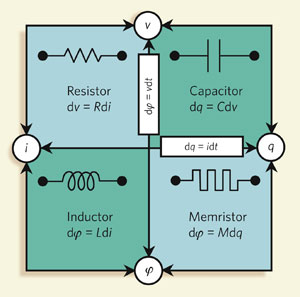
The concept of Memristor starts nearly 4 decades ago when in the year 1971 Leon Chua (a professor of electrical engineering at the university of California ) postulated the existence of a fourth fundamental element after examining the relationships between charge and flux in capacitor, inductor and resistor. Till that time for nearly 150 years capacitor, inductor and resistors were considered as the three fundamental passive circuit elements.


The 4 element would give the same relationship between charge and flux that is given by a resistor for voltage and current. Such a fundamental element would behave like a resistor whose value would vary according to the current passing through it; but it would be able to remember that value even after the current disappears.

Long since it was theorized no one was able to built it. It became a concept of profound curiosity. But in the year 2008 the researchers of  Hewlett-Packard Stanley Williams and his group revealed that they have discovered the 4th element. "The Memristor". 


         Memresistor crossbar architecture
 
The architecture of Memresistor is a mesh of perpendicular wires known as crossbar arrays; in which memristors are sandwiched between the crossing points.  

Memristor is a two terminal device whose resistance depends upon the magnitude and polarity of the voltage applied to it and the length of the time for which the voltage has been applied. If you  turn off the voltage the memristor is able to remember the recent resistance until the next time you turn it on whether it is the next day or a year later.. That means if you are working on a spreadsheet on your computer, and you turn it off  without closing the documents you will get it as it is the next time you turn on your computer.

This effect can be duplicated by any circuit combination of  resistor, capacitor and inductor that is why the Memristor is termed as the 4th fundamental element.


                     Stanley Williams (left)

You need to boot your computer as the logic circuits do not hold their bits after the power is turned off. But as Memristor is able to remember its history, the wide application of it would be in non-volatile memories. So a computer driven by memristor won't need a reboot. Hence processing time would reduce with much flexibility in computation.

Overall Memristors can be made extremely small and they can be used to make analog circuits working on the same physical principles as a brain. Such a circuit would even lead to machines that can recognize patterns as humans do, real time data analysis for multiple sensors, intelligent physical infrastructure that can provide structural assessment and so on.


read more...

Thursday, December 16, 2010

Autonomous Power Efficient Microchips Generating Its Own Power.


          Solar cell generated within the layers of microchip

Power management and reduction of area required in a microchip are the two most important fields researchers are working upon.
Autonomous chips are created by harvesting solar energy to meet the power supply requirement of the chip by embedding a solar cell separately at its top. 


This type of chips won't require any battery or any other external energy sources. Hence they are very useful in wireless communication and space technology for their power efficiency.
But researchers have now succeeded in finding out a more efficient production process.They used a chip as a base and applied the solar cell to it layer by layer. 


One major advantage of this is that the chip would require fewer materials and hence performance would increase. Also it is highly suitable for industrial serial production.
The prototypes so far constructed showed that the electronics and the solar cell worked perfectly.
read more...

Friday, June 18, 2010

10 Best Motivational Songs to Make You Roar.


So many times, it happens too fast, you change your passion for glory. Don't lose your grip on the dreams of the past.You must fight just to keep them alive. A collection of 10 best motivational songs which will drive you, motivate you and make you roar in your difficulties.

Remember: "All the Powers are within You. You can do anything  and everything. So stand up be strong, be bold and know that you are the creator of your own destiny." -Swami Vivekananda

1. Eyes Of The Tiger- Survivor
http://beemp3.com/download.php?file=6516371&song=Eye+of+the+Tiger
2. I've Got The Power- Snap
http://beemp3.com/download.php?file=6523652&song=
3. Chariots of Fire- Vangelis
http://beemp3.com/download.php?file=2716203&song=Chariots+Of+Fire
4. It's My Life- Bon Jovi
http://beemp3.com/download.php?file=7672681&song=It%27s+My+Life
5. The Final Countdown- Europe
http://beemp3.com/download.php?file=4066360&song=The+Final+Countdown
6. We are the Champions- Queen
http://beemp3.com/download.php?file=7003547&song=We+Are+The+Champions
7. The Prayer- Celine Dion & Andrea Bocelli
http://beemp3.com/download.php?file=7127392&song=The+Prayer
8. We will Rock You- Queen
http://beemp3.com/download.php?file=7610310&song=We+Will+Rock+You
9. Affirmation- Savage Garden 
http://www.4shared.com/account/audio/vs3VOE7P/01_Affirmation.html
10. Here I Am- Bryan Adams 
http://beemp3.com/download.php?file=7647959&song=Here+I+Am

Though it is not related to electronics but sometimes it requires more than knowledge to keep our moral high. I could not resist sharing these songs with you, as this songs are really close to my heart. Whenever I feel low I listen to the songs; to raise my inner self, conquer my challenges. I hope you will like this songs.
read more...

Wednesday, June 16, 2010

Changing Trends In Nanocircuits


Nanocircuits can be explained as a simple electrical circuit, at a dimension such that the quantum mechanical effects become important to be considered.  It's size ranges within 10-9 meters. The concept of nanocircuits arose when Intel's co-founder Gordon Moore suggested that the number of transistor that can be fabricated on a silicon integrated circuit will double every 18 to 24 months. More the number of transistors, more will be the speed of the computer.

But why should we worry about fabricating a transistor, can't we obtain a similar performance using resistors, capacitors or diodes?

The reason behind this is, transistors can act as a switch and can quickly turn on and turn off, regulating the flow of electricity. They can even amplify a signal ie; transforming a weak signal into strong signal. Most of the transistors we use in a circuit are silicon transistors. But opposite to this, when we are dealing with a nanocircuit silicon transistors cannot be used. It's because the silicon transistor of today are as small as allowed by the laws of physics and the resistivity of the circuit increases when the size shrinks to 30 nanometers.

So, it became a necessity for the Scientist and Engineers to device an alternate way if they wanted to add more functionality and reduce the size at nanoscale. So what they came up with, was a atomic scale wire made of carbon atoms and bonds. They named it Graphene (graphite+ene). Graphene is one atom thick  densely packed carbon atom bonds structured as a honeycomb crystal lattice. (See the above image) They are actually insulating materials but when the temperature is increased they act as conducting material.

Scientist are enthusiastic about graphene as the electrons meet with less resistance when they travel along graphene and also because they are faster and consume less power. Till now nobody knew how to produce graphene nanostructures on such a reproducible method. 


But recently some scientist claim that they have devised a simple one step process based on thermochemical nanolithography (TCNL) for creating nanowires from reduced graphene oxide.

Use of graphene interconnect could facilitate in integrated circuit performance once sizes drops to approximately 20nm. Also the high mobility of carriers in graphene could allow the fabrication of FETs with low channel resistance resulting in a high operational speed. The figure below shows a first ever logic gate and complementary inverter developed on graphene.

read more...

Tuesday, June 8, 2010

Apple's Solar Powered Touch Screen


To survive in this competitive world you need to explore new realms of technology, and "Apple" knows it very well. Today one of the major requirement is to cut down power required by a device or to use renewable energy sources.

Engineers from Apple have come up with a concept of Solar powered touch screen and they have filled a patent for the same. Though they have not released a solar powered gadget but their engineers see a wide potential in multitouch devices and believe to embed it in iPhone and iPad. Above is a diagrammatic representation of this concept where a solar cell is placed under a touch screen of hand held devices. 

The patent describes to use the parabolic reflectors as light channels to direct light to the solar cells underneath the touch screen. The solar panel will be designed such that it will absorb light from the top and also from the glass covering the back. But embedding a solar cell into a device and keeping it significant to gadget's cost is more challenging than stating a theory. In theory the solar cell will be able to use indoor lights rather than only direct sunlight. 

read more...

Friday, June 4, 2010

Smart Cars Communicating With Traffic Signal.


With the growing numbers of cars on the road, traffic is increasing at an enormous rate. Thus longer will be the time you will have to wait in the traffic signal. But consider a situation where your car need not have to wait, as every time you approach a signal it appears green. WOW! (that's what you will feel)

It's not a hypothetical thought, but with the blending between automotive and electronics industry many such smart cars are being produced. German car company AUDI has made a prototype named Travolution which can talk to traffic signals using LAN and UMTS links interrogating them about the color changing time.

The data sent by the signal is converted into graphics by the system. This then tells the driver what speed to adopt so that the next traffic changes to green before the car reaches it. In the same way if the car is waiting in the red signal the system will tell the driver how much time is left for light to turn green.

These Smart Cars Communicating With Traffic Signals will definitely help to save our time and most important, fuel consumption by 0.02 liter for every traffic signal stop. Though 0.02 may not look bigger but this small figure will help to reduce two million tons of CO2. A great life savior technology for our endangered Earth. What do you think about this technology? Do write to us.
read more...

Wednesday, June 2, 2010

Get Inspired.

Dear friends; if you dream of exploring the unknown path of technology but you are scared whether it is feasible or not then here is something inspiring.


Vivek Anand a 3rd year Information Technology student from Govt. Engg Collage Bikaner, and his three other group members had deviced a multi-touch screen technology "Sparsh" which can take 10 commands in a single go. See this video below before you continue reading.....


Back in the year 2008 Anand, and his collage mates Anirudh Sharma, Rahul Motiar and Sudanshu Gautam thought of developing a system which can make computer interaction simpler. They weren't sure of the outcome. But with firm determination, and devotion towards their work, they started the project. And now after two years of persistence their project paper is being published at ACM International Conference on Interactive Tabletops and Surfaces 2010 which will held at Germany.

The team also won the first prize in open hardware and best hardware project in IIT Kanpur. There it was also observed by NASA's scientist David Hanson. But their was more glory awating. The project won 20 awards which includes first prize from IIT Delhi, IIT Mumbai, BITS. It was even recommended at  Google Summer of Code.

The technology has a vast area of application including locating landmark, up-link information on cellphone, providing an enhanced multimedia experience, gaming, mapping etc. Riding high with confidence; these boys were also offered by an entrepreneur to put the technology in railway stations.

So, isn't it inspiring! Don't be pushed by your problems, be led by your dream. Because dreams are like the paints of a great artist. Your dreams are your paints, the world is your canvas. Believing, is the brush that converts your dreams into a masterpiece of reality....
read more...

Tuesday, June 1, 2010

Peering Into Reverse Engineering


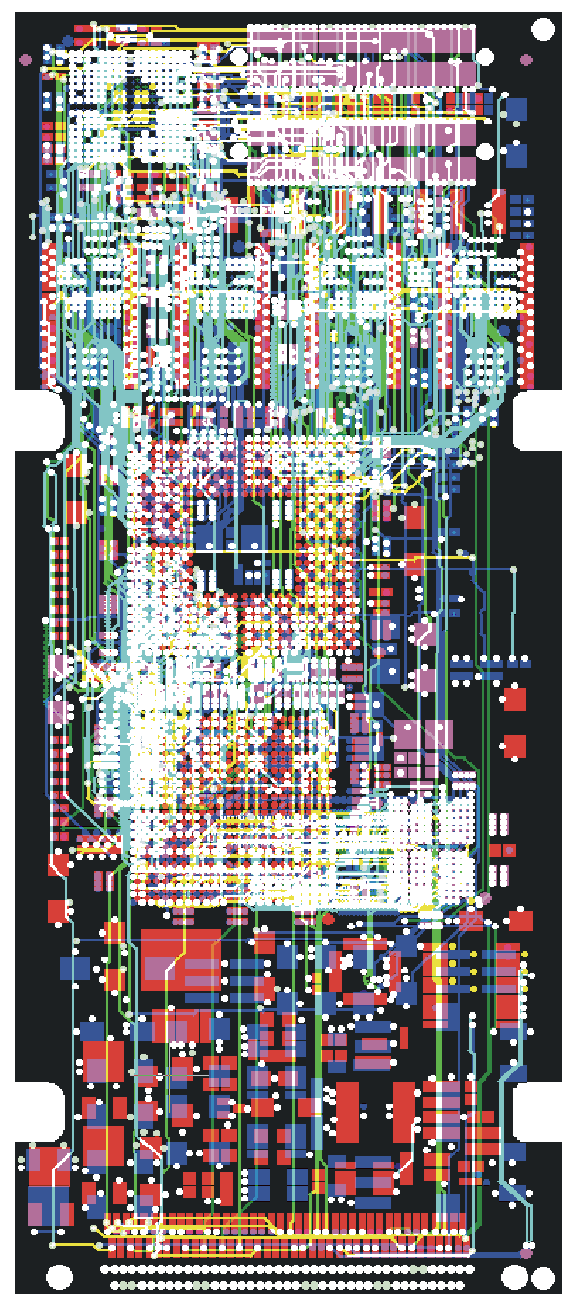
Have you ever thought of buying an Ipad or Iphone and tear it down into pieces to peer inside its integrated circuits and processor. No! I know you are not that Einstein. But researchers form chipwork make it their business to find it out. They buy mobile phones, laptops and reverse engineer the hardware, ICs and derive the complete schematic diagram.

Actually the reverse engg. process has long been recognized in semiconductor industry. For example to get a piece of silicon from plastic package, is dipped into a beaker of acid. For ceramic and metal can packages different complicated process are followed. 

So what new reverse engineers found after tearing down Ipad was 16Gbyte memory powered by two Samsung K9LCG08U1M 8Gbyte flash Nand memories; and instead of  Texas Instrument's touch controller do all the touch screen controls as in Iphone 3G they used three- chips as their earlier version of Iphone 2G.


Image: Inside Apple Ipad a)Metal Layers b)Transistor details c)Circuit Layout.

But the most difficult portion is to peer into smaller and delicate designs. With the use of powerful electron microscopes like SEMs (scanning electron microscope) and TEMs (transmission electron microscope) magnification till atomic level is feasible. With the analysis of cross-section and planar section of the layers, images are merged in a software like ICwork and a schematic is obtained.


Image: Schematic obtained of Bootstrap Oscillator circuit from SmartMOS DC/DC converter

But a question still arises whether reverse engg. is legal. In US according to Semiconductor Chip protection act the technique is allowed for the purpose of teaching, analyzing and evaluating the concept. Similar law exists in European Union, Japan and other jurisdiction. But with the growing competitive intelligence people involved in patenting are evolving with new techniques and designs which are hard to debug and reverse engineer.

read more...

Saturday, May 1, 2010

Generate Electricity With Every Move You Make Every Step You Take.


Have you ever wondered generating electricity merely by walking over a distance. If not then you will be amazed to know that scientist from Georgia tech University has developed a device which can generate power from body movement.

They have used Piezoelectric materials and drawn them into nanowires that can be woven into cotton shirt or housed into shoe hill. Piezoelectric crystals have a special characteristic that when they are subjected to force or pressure they produce electric signals. Though this electric signals are very weak but by cramming 20,000 nanowires into three square cm area can produce power in millivolt range.

With every move and every step you take pressure is applied on the piezoelectric crystal and electric signal starts flowing through the electrodes. It may not be possible to turn on an electrical appliance but at least atleast cellphones and ipods can be easily charged.


Single nanowires are invisible to naked eyes. Prof Z.L.Wang and his team at Georgia tech are using Zinc Oxide nanowires to built this nano generators. This nanowires are 50 to 200 nanometers in diameter and 5 micron in length. 2 thin electrodes are used and place between this 20,000 nanowires to drive current from it.

This arrangement helps to maximize the electricity produced by piezoelectric crystals. But if the zinc oxide is replaced by Gallium Nitride the power output could increase by 10 times.

If the device is not in constant motion then the nanowires will shut off and no electricity will flow. To rectify this Prof. Wang will develop supercapacitors to store the charge generated by the nanowires. 

Till now only a prototype is made and lots of work is needed to be done. It is likely to take 3-4 years before you can actually get a cloth of nanowires and put the concept into action. Till the time hold on and wait...
read more...

Sunday, April 25, 2010

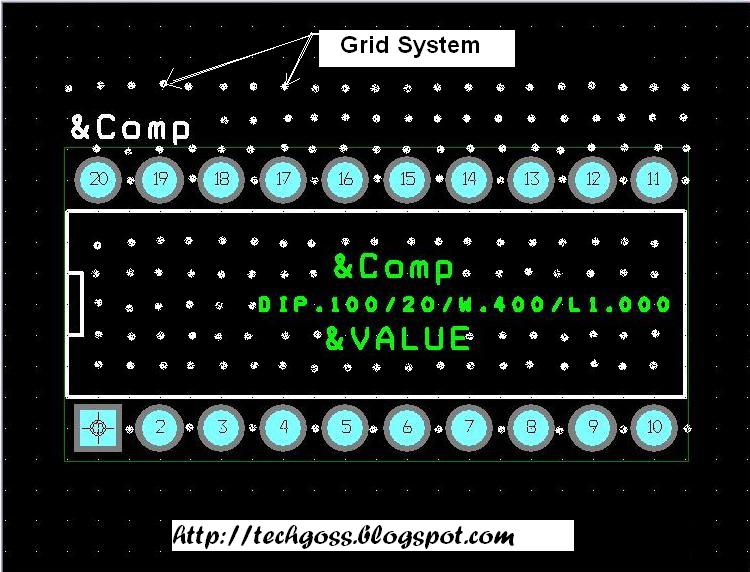
Parameters of Layout Check while Designing a PCB : 2 [ Grid System]


Grid system is basically required to get an accuracy while drawing the hole location of a component. The use of grid gives more convenience in placement of components and conductors on the PCB. It is a general practice to use grid system in layout designing.

By using the grid system in the artwork preparation stage the pads can be placed at exactly the center of the grid intersection. In the modern times the grid system is present in your PCB designing software itself. Using a grid of 100mil is adequate. But if you wanna shrink your PCB then grid of 50mil is also acceptable.

As the design becomes more and more complex finer and finer grids are required. Universal  grid system is based on the 0.05mm unit. For all shape and sizes and for every aspect of the PCB layout grid size should be incremented as the multiple of  5; else routing will be quite difficult.

Want to know more about grid system PCB design org >>
read more...

Guide To Conquer Electronics [Resistors]


Resistors are the simplest components of electronics. There's nothing great that you may find difficult to understand. Moreover there are tons of sites on the net that are loaded with the of concept of resistors. But one thing which  I have found similar in all these sites are; they discuss about what the resistors actually are and how we can determine the color codes. But none of them discuss about the different types of resistors and which type of resistor should be used where. 

So I decided to come up with a Guide to Conquer Electronics with an idea to explore the applications of different components of electronics and their types.

While designing a circuit it is very important to maintain proper current and voltage level across different components for proper operation of the circuit. If excess of current is flowing then it can be brought down using resistors. Resistors are available in different ohm ratings and different wattage.


The guide covers all this subjects with a pictorial representation. Pictures will help you for the better identification of the component, its package type, and space required on the PCB.  I hope the Guide to Conquer Electronics will be advantageous  for you in better circuit designing.
If you are unable to understand the concepts of electronics like JFETs, voltage regulators, Ac modeling then we have electronic movies a fully animated program in store for you. Visit EMovies >>

read more...

Wednesday, April 21, 2010

Evoulation of Radio Astronomy: The Complete Story.


The age of radio astronomy began from the day when engineers learned to generate radio waves using an electron tube. Approximately after a decade from the discovery two young and dynamic engineers Gregory Breit and Merle Tuve, bounced radio waves off the ionosphere and determined the height of the layers. This proved that radio waves can travel beyond earth and back and they can be used as a probe for communication. 


Two years later a well known American inventor, writer, and magazine publisher Hugo Gernsback popularly known as father of science friction proposed an article "Can We Radio The Planets". The radio waves that can be bounced from the moon and the planets. He also stated that 2.5sec will be required for a radio wave to travel to the moon and back.


In the years of 1930 Karl Guthe Jansky at Bell Telephone Laboratories investigated the noise sources in radio transmission. Jansky used a large directional antenna of 14.6m wavelength which identified three different types of static noise. Noise signal from local thunderstorms, a steadier (ie; firm in position) and weaker static from distant thunderstorm and a weak hiss from unknown source. 

The weak signal from the unknown origin peaked about every 24 hours. Firstly Jansky suspected that this unknown source was sun crossing the view of his directional antenna, but when Jansky compared his observations with the optical astronomical maps, he concluded that the radiation was coming from the Milky Way and it was maximum in the direction of center of galaxy.

But instead of encouraging the research of Jansky; Bell's laboratory rejected Jansky's request to build a 100 foot radio telescope. No other institution followed Jansky's work.

Only after World War II a radio engineer Grote Reber took Jansky's work and continued it as a hobby in his spare time. He built a 31-foot parabolic antenna and in 1937 made the first radio map of the sky. With the intense development of radar technology during the world War II gave a new aid to astronomers. 

 
A team headed by J.H. De Witt of U.S. Army Signal Corps were succeeded in seeing the echoes of the moon on the cathode ray tube .
From then there was no turning back and in the years of 1940-50 radio astronomy emerged as a new branch of astronomy. A 76m steerable radio telescope was built in England at Jodrell bank in 1957. 


While a 305 meter fixed reflector was completed in Arecibo Puerto Rico in 1963. It is the world's largest radio telescope made till date.

read more...

Saturday, April 17, 2010

Parameters of Layout Check while Designing a PCB : 1 [ Layout Scale ]


The layout of a PCB has to incorporate all the information on the board before one can go on to the artwork preparation. Layout check is a concept which clearly defines all the details of the circuit & partly also of final equipment. It is a prerequisite before the actual layout can start.
For a design engineer the parameters to be considered for planning the layout of a circuit includes layout scale, grid system, board types, circuit diagram, component list, layout sketch, artwork preparation, component mounting, layout check, resistance, inductance, and capacitance. Let us see how we can implement this parameters effectively while designing a PCB layout. A series of post will cover every single topic mentioned above.

< Layout scale >
Depending on the accuracy required, artwork should be produced at a 1:1 or 2:1 or even 4:1 scale. The layout is best when prepared on the same scale as artwork. 

If you didn't understand what this means, then consider an example. Suppose your desktop wallpaper's resolution is  1024 x 768. And let us say this resolution signifies a normal ie; 1:1 scale for your desktop. But at the same time you can also zoom the wallpaper to say 1600 x 1200 representing a 2:1 scale. Thus this scale represents nothing but a zoomed version of your artwork.

layout scale

A 2:1 artwork has 4x actual PCB area and a 4:1 artwork has 16x the PCB area. Normally a 1:1 scale is considered while transferring the artwork on the PCB.


read more...

Sunday, April 11, 2010

Optimum Package Density of PCB.

Components Package Density
An optimum package density of a printed circuit board results into better electronics performance at a reduced cost and gives the impression of an optimum design. The package density is linked with many constraints.

- Purpose & use of the equipment whether airborne, portable or permanent/ fixed installation.

- Heat produced and cooling provisions that is whether hermetically sealed, natural air flow, forced cooling.

- Types of components on the board; silicon devices have a shorter life, higher the temperature.

- Types of PCB used that is whether single sided, double sided or multilayer PCB.

- Component technology used whether discrete semiconductor, SSI, LSI.

The density of a board can be measured by the number of connections per square inch or the pad count per square inch. Connections between 65 to 120 is considered dense.

Package density is important to be considered in the earlier stages of design process. It is because if the density is very low, more PCB's will be used to realize the same circuit. This will result into more volume of the equipment, more PCB connectors & back panel wiring with more parasitic influences on working Circuit.

read more...

Monday, February 15, 2010

Engineering Goes Sexy...


With the new career of Barbie in the year 2010 as a Computer Engineer; engineering also becomes sexy. This will be the 126th career change for world's most famous and favorite doll; after being a Pop star, Photographer, Athlete and so on. In an online poll conducted; Computer Engineer beat out Environmentalist and Architect.

Accessories of Computer Engineer Barbie will include pink glasses, a bluetooth earpiece, a pink laptop, a t-shirt printed with binary numbers and a smart phone.

So dear engineers get your piece of Barbie today :)
read more...